


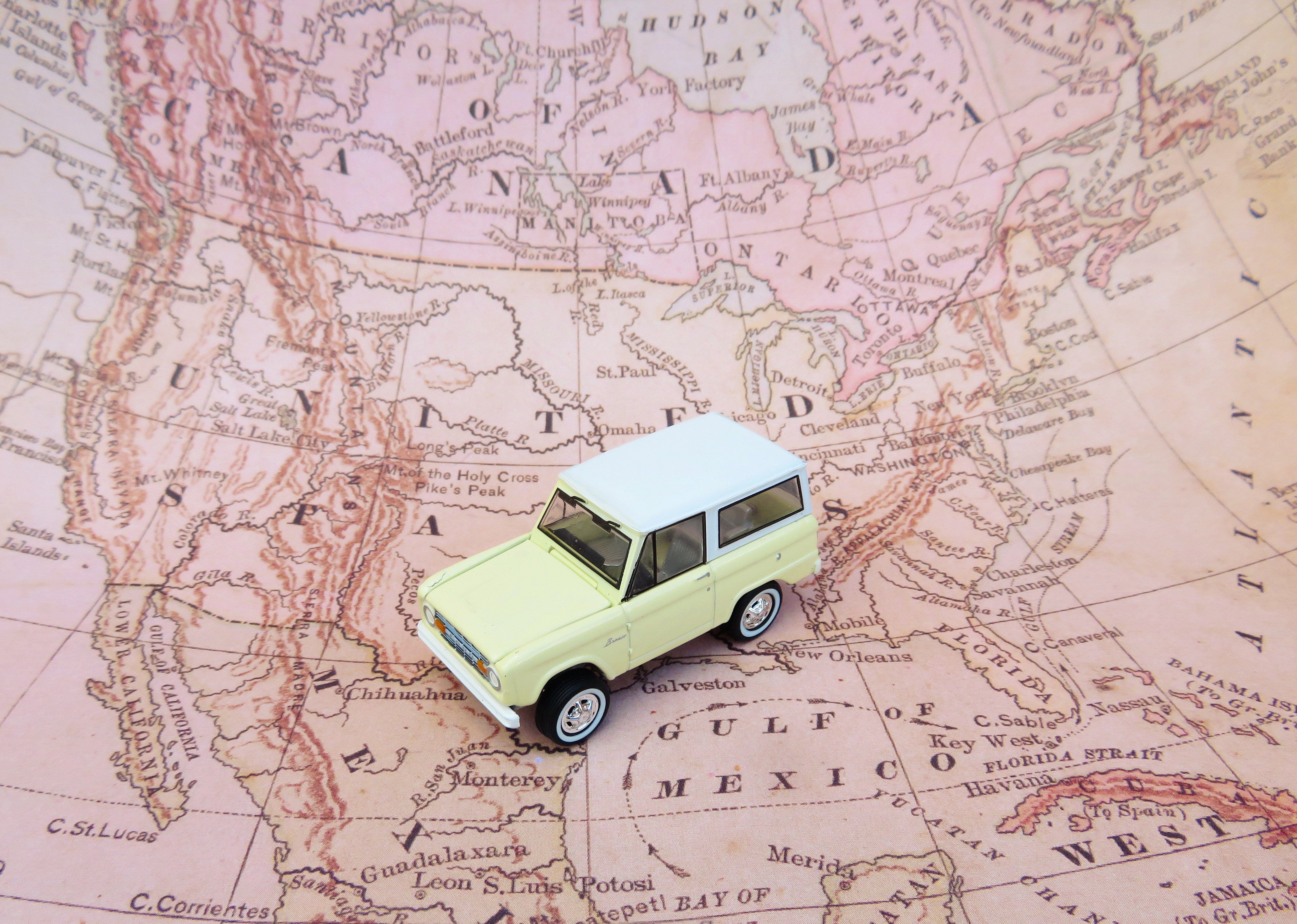
I come from a long lineage of map-gazers. My grandfather, the dreamer—so I was told by my dad—used to lean back in his recliner and read maps for fun, like a good novel. My dad, more the planner, greatly enjoyed the map-reading and map-marking part of family vacation planning. I can still picture us, parked at some interstate rest stop or pulled over on the side of a gravel road in our big green camping van. My dad would sit in the driver’s seat with the engine idling, studying an open map spread out over the steering wheel. In those days, he may have even had an open can of Coors in the dashboard drink holder, his sunburned left arm invariably perched elbow-out through the open window.
He had a distinctive way of tapping the map twice with his pointer finger with much satisfaction when he finally settled on our route to the next destination. “Whad’ya say we take such-and-such pass, come on down through such-and-such town, and then head on over to such-and-such campground,” he would ask my mom, his mind of course already made up. With an affirmative agreement, he would proceed to carefully re-fold his map—always properly—and place it back into his map stash in the driver’s side door.
Just as our map reading progressed from my grandpa’s dreaming recliner to my parents’ big green road trip van, my own affinity evolved toward trail and topographic maps when I discovered my love for the wilderness. My favorites are the National Geographic Trails Illustrated series, but I have many other types as well, collected over the years from various backpacking trips and as-yet-unseen wilderness destinations. I have maybe a couple hundred of them, tucked away in a stack of shoeboxes (shoeboxes are the perfect size for a foldable map collection).
I inherited a half-dozen shoeboxes full of maps from my dad when he passed away in 2014. Over decades of summer family road trips, he had accumulated and reverently tucked away every state road map, every national forest map, and every national park brochure with any kind of map included—all neatly organized by region and often hand-dated. Some of these maps go back more than 60 years now. I believe the collection includes a complete national set of US Forest Service Recreation maps—in my opinion, the best multi-purpose transportation-recreation maps ever produced, and still the best single physical reference for national forest campgrounds available in a single view.
There are just some things a computer screen and the internet can’t replicate, and a good paper map is one of them. They are, however, going out of style. Although I always say it’s essential to carry a paper map on the trail at least as a backup because electronics can always fail, even redundant ones (that’s the Eagle Scout in me), the reality is that for many hiking excursions, paper maps are becoming less essential. There are incredibly accurate and useful mapping applications nowadays that can do way more than any paper map (I use onX Backcountry as my go-to myself). As long as you have a redundant power backup, you can reasonably get by without a paper map these days. But… I will always say it’s better to have that paper backup.
And if you expect to spend much time in the wilderness, you should also know basic map-and-compass orienteering (again, the Scout in me talking). In practice, nothing can really replace the large-format utility of a foldable paper map. A tech app can track your location and progress—and yes, they are much better than paper maps for helping you stay on route and not get lost—but the broad, aerial perspective of a paper map gives you a sense of location within the context of an area. It shows you where the river bends down-trail, or where alternative routes and scenic spur trails might be located.
Besides, there’s something nostalgic about opening up a map at a campsite or in the tent by the light of a headlamp. Perhaps my affinity for paper maps is just my dreaming grandfather smiling down from his recliner. And, like my dad, every map I procure—whether purchased or picked up for free at some trailhead kiosk—goes right into a shoebox in my closet, properly folded and neatly organized by type and location.