


Two years ago, Yellow Scene Magazine published my first-place Colorado Press Association award-winning article, “The Colorado Water Emergency.” Predictably, the seven Colorado River basin states still cannot agree on an updated and sustainable water allocation plan to save the river. The ongoing gridlock between the states may soon force the hand of the federal government—all three branches of which are currently controlled by politicians who are often hostile to conservation and environmentally sustainable policies.
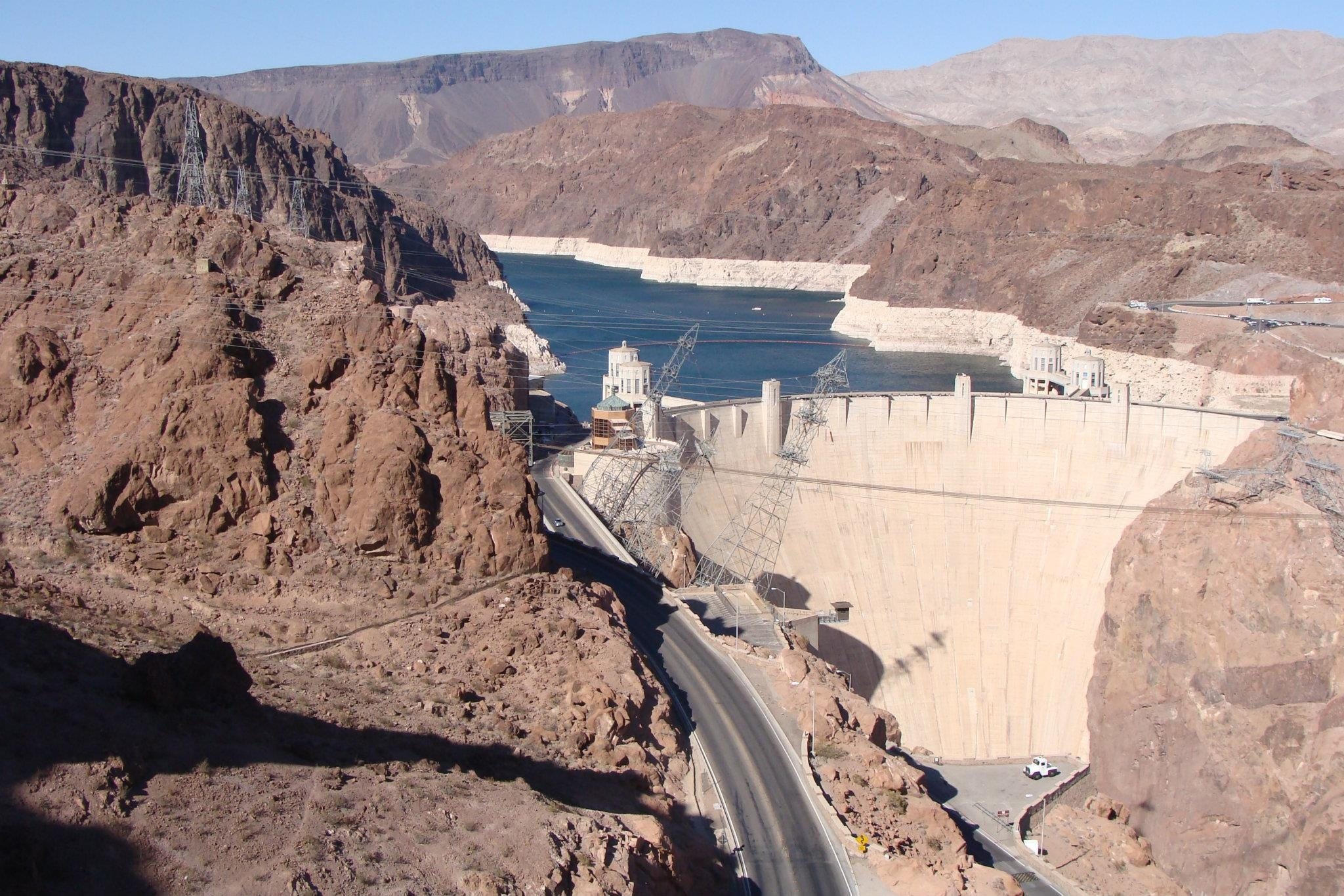
As of this writing in June 2026, Lake Mead’s water level sits just nine feet above its all-time record low set in 2022, and is currently projected to smash through that record low by mid-2027. Most of the river’s massive basin is sweltering under moderate to extreme drought conditions following a La Niña-driven, low-snowpack winter. To put it into perspective: the lake is currently at only 35% capacity and heading lower. The last time the water line plummeted this low, long-dead bodies started emerging along the muddy shoreline—unrecovered drowning victims and a Las Vegas mob hit or two.
Upstream of Lake Mead, Lake Powell’s level continues to drop, steadily revealing side canyons and desert land formations drowned long ago by the Glen Canyon Dam.
The fundamental issue here is simple, but the solution is mired in a complex entanglement: managing skyrocketing water demand within an outdated, flawed allocation system, all while a 21st-century Southwestern megadrought drastically reduces the supply. The century-old Colorado River Compact, which originally divided the water rights among the seven basin states, was negotiated during a period of historically high water abundance. As a result, our current allocation model is based on 16.4 million annual acre-feet of water for a river that, over the last quarter-century, has only averaged about 12.4 million acre-feet of water flow annually.
Consumptive use has outpaced the water supply for years, causing the “bank” of water stored in Lakes Mead and Powell to steadily drain. Dishearteningly, the Colorado River now completely dries up long before it can reach its mouth in the Gulf of California in northern Mexico, turning a once-vibrant river delta wetland into a dusty wasteland.
According to the U.S. Bureau of Reclamation (USBR), Lake Powell is on course to drop below “dead pool”—the point at which the water drops too low to generate hydroelectric power—by October of this year. Preventing this will require massive, emergency water releases from Flaming Gorge Reservoir upstream, combined with drastically reduced releases from Glen Canyon Dam which will accelerate the water level drop downstream in Lake Mead, already critically low. The entire catchment system in the Colorado River Basin is on the brink, threatening the power supply for millions of people in the Upper Basin and risking irrigated crop production farther south in California’s Imperial Valley—one of the nation’s most crucial agricultural lifelines.
But the situation is not hopeless, even if the seven basin states remain gridlocked. While it is convenient to blame the water crisis on extravagant Las Vegas fountains and desert golf courses, the thirstiest sector by far is agriculture. Much of that regional agricultural production is dedicated to growing cattle-feed crops like alfalfa and hay—practices that researchers have consistently determined to be inefficient, non-essential, and increasingly unsustainable in a desert.
At this point, the federal government is still pushing for a consensus among the seven basin states. The USBR has floated five different compromise frameworks, but none have been deemed acceptable by everyone. The core friction remains the traditional split between the Upper Basin states (Colorado, New Mexico, Utah, and Wyoming) and the Lower Basin states (Arizona, California, and Nevada). It’s a fundamental geographic challenge: the majority of the water demand comes from the Lower Basin, but the water itself flows from the snowpack of the Upper Basin.
Western U.S. water rights law is notoriously complicated because out here, water rights typically go to whoever used the water first, regardless of who owns the land where the water actually flows. There is a fascinating saga that played out near Denver way back in the 1870s that helped codify this “doctrine of prior appropriation.” Basically, a group of Front Range Colorado settlers trekked up into the mountains and altered an entire stream system with an earthen dam to divert water to their farms miles downstream on the Great Plains. While it was an ingenious feat for these Iowa-born ditch diggers, it caused an uproar among the settlers farther north, who woke up one morning to find their own creek completely dry.
Those northern settlers naturally ventured upstream, found the diversion, and promptly blew it up to restore their water. Back and forth they went, rebuilding and blasting, until things escalated into a brief gunfight known locally in Colorado as the “Lefthand Creek Water War.” When the parties finally took the matter to court, a judge ruled in favor of the downstream diversion group based on “first use, first rights.” It was one of the very first major western water rights court battles, establishing the legal blueprint we are still bound by today. The water diversion remains to this day, now managed by the Lefthand Ditch Company.
A similar situation is now playing out a century and a half later on a grand scale. Downstream and off-river water rights holders are locked in legal combat with upstream advocates. To complicate matters further, Mexico holds a stake based on a mid-20th-century treaty that guarantees them a few drops in the bucket of what’s left of the river as it crosses the border near Yuma, Arizona.
The final, vital layer of complication lies in tribal water rights. There are 30 Native American tribes who hold legal, senior rights to divert a combined total of 3.4 million acre-feet of water—approximately a quarter of the river’s current average flow. Collectively, the tribes have only used about half of their recognized rights so far, but major upcoming pipeline projects are expected to increase their usage, further reducing the water available to everyone else.
The dam is about to break on this crisis—pun intended—and that might actually be a good thing. Something has to give. A compromise is the only way forward because the alternative of a reservoir dead pool simply isn’t an option. If the seven basin states cannot come to a collective agreement, the federal government will be forced to step in and dictate a solution soon. The bad news, of course, is that Washington is rarely the best arbiter of local fairness or regional wisdom. Especially, in my humble opinion, under the current administration which is often unfriendly to conservation and environmentally sustainable interests.
Perhaps fortunately, this is one rare case in modern American politics where the battle lines aren’t cleanly partisan. The Lower Basin states are an unlikely alliance of deep-blue California and purple Arizona and Nevada. The Upper Basin is an equally strange pairing of solid-blue Colorado and New Mexico with solid-red Utah and Wyoming. The states aren’t voting party lines; they are looking after their own citizens’ water security. Red, blue, or purple, the states need to get their act together and hammer out a compromise they can all live with before the feds hand down a mandate that none of them like.
For us water consumers, every viable solution requires some form of sacrifice to correct the math of this historic overallocation. Every path forward demands a reduction in use, and that likely means a major disruption to western agriculture—specifically transitioning to less thirsty crops or reducing yields to match a permanently lowered water supply.
The optimist’s perspective is that this problem is entirely solvable if we can just agree to use the river’s water more efficiently and sustainably. But we must get used to a stark new reality: barring a miraculous sustained reversal of the megadrought, Lakes Mead and Powell will not be returning to full pool anytime soon, and California’s Imperial Valley farmers might have to make do with less water flowing through those massive irrigation canals.
Sources:
https://legis1.com/news/colorado-river-water-crisis-deadline-looms-in